
Justice remains elusive 19 years after Jaffna journalist’s killing
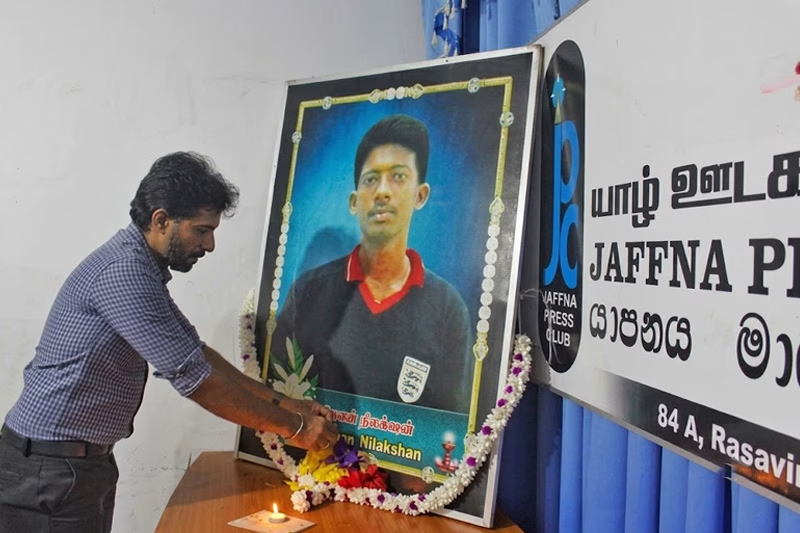
Justice remains elusive nineteen years after the killing of a young Tamil journalist in Jaffna, as a memorial service was held in his memory over the weekend.
The remembrance for Sahathevan Nilakshan, who was shot dead at the age of 22, was held at the Jaffna Press Club on 01 August.
Nilakshan was killed at around 5.30 a.m. on 01 August 2007, during the first Rajapaksa government, when gunmen arrived on a motorcycle and shot him in front of his home on Railway Station Road in Kokuvil West, Jaffna.
He had been lured out of his house by the perpetrators, who used a friend to summon him outside before carrying out the attack.
At the time of his death, Nilakshan was a part-time journalist studying mass communication at the University of Jaffna, and also served as editor of Saaralam, a popular student publication.
Journalists from Jaffna, together with Nilakshan’s relatives and other members of the public, gathered for the 19th memorial of his killing and paid floral tribute before his photograph.
Addressing the gathering, President of the Jaffna Press Club K. Selvakumar said that successive governments, including the present one, had failed to deliver justice for journalists who had been murdered.
He questioned what had become of the 39 journalists who had once worked alongside him, and asked whether the NPP government was also shielding those responsible.
He recalled that the Anura Kumara Dissanayake-led government had, prior to assuming office, pledged to carry out the investigations necessary to secure justice for slain journalists, but said that two years into its term, it had remained silent on the matter.
He noted that the current government was behaving no differently from its predecessors in this respect.
Selvakumar further said that a democratic country could not simply set aside past atrocities on the grounds that they belonged to history, warning that doing so raised doubts over whether such a country would remain democratic in future.
He stressed that genuine national progress, including economic progress, could only be achieved once justice had been delivered for such incidents.
According to a list of 44 murdered journalists and media workers published by Journalists for Democracy in Sri Lanka (JDS), the majority of those named were Tamil journalists who had reported from the Northern and Eastern parts of the country.
No government to have held office since Nilakshan’s killing has conducted a proper and impartial investigation into his murder or into the deaths of other journalists killed in the North and East.


