Banning Theepchelvan is censoring victim centered literature
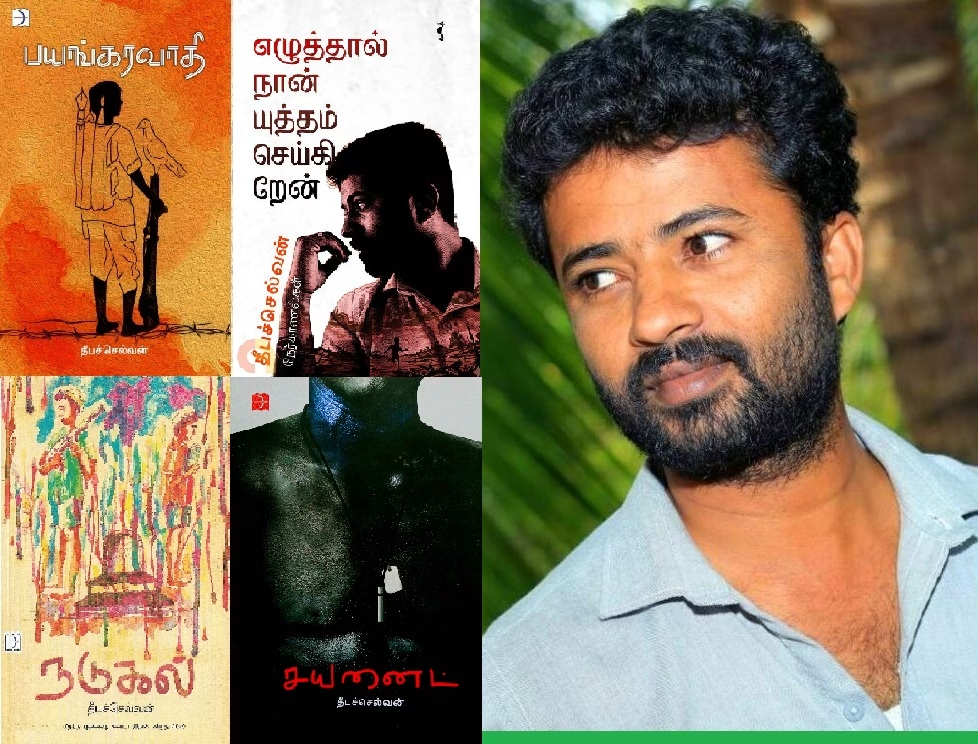
Sri Lanka authorities’ detention of Tamil books by Theepachelvan Piratheepan reflects a deeper political logic rooted in the post-war order established after the Civil War. It does not seek reconciliation. Instead, it attempts to take control over memory, narrative, and dissent. Thus, the issue of Theepachelvan is not an isolated act of censorship.
The justification given for this censorship, can be seen echoed by sections of the pro-government cultural figures, that leans heavily on the need to preserve “ethnic harmony” and protect what they describe as “hard-won reconciliation.” Yet this language does more than explain the censorship, as it reveals the ideological framework within which such censorship is normalized.
Today, in Sri Lanka the “reconciliation” is increasingly being equated not with justice or pluralism, but with the stability of the current political order of the island. In this formulation, dissent – especially from marginalized communities – is recast as a threat.
What “harmony” is being protected?
Even more than fifteen years after the blood-soaked end of the civil war in 2009, the fundamental grievances of Tamil war victims remain unresolved. Families of the disappeared continue their protests, demanding answers about loved ones who vanished into thin air – many after surrendering to state forces in the final stages of the war.
Across North and East Sri Lanka, allegations still persist regarding ongoing land seizures by military and state institutions, alongside the continued occupation of private lands acquired forcefully. The discovery of mass graves reopens wounds that the state insists as closed. Mothers and Fathers who have spent years searching for the truth and justice for their children are aging and dying without answers.
Harmony or enforced silence?
Any claim to shut the voices for justice is not harmony. It is enforced silence. And such silence is not accidental. The state, as an instrument of class and national domination, requires a controlled historical narrative to maintain its legitimacy. In Sri Lanka’s case, the dominant narrative frames the war as a binary conflict between the state and the Liberation Tigers of Tamil Eelam, culminating in a “humanitarian victory.” Within this framework, there is little space for the voices of victims; particularly those whose suffering implicates the state itself.
This is precisely why the works of Theepachelvan are treated as dangerous. He speaks from the standpoint of those crushed, the disappeared, the dispossessed. His writings disrupt the neat binaries that the post-war order of Sri Lanka depends upon.
The selective nature of censorship in Sri Lanka exposes this contradiction. Former soldiers have published memoirs and accounts of the war, often celebrating military victory. Likewise, writings by former LTTE cadres circulate, and some have even been translated into Sinhala. These narratives, while politically sensitive, can still be accommodated within the broader framework of “two sides in conflict.”
But a literature centered on victims – one that raises unresolved questions of accountability, justice, and state violence – cannot be so easily absorbed. It threatens to expose the violence of the war and its aftermath.
Safeguarding the State from public disaffection.
Sri Lanka Customs has informed that the retained books, except for two, have been approved for release, as per recommendations from multiple state bodies – the Arts Council of Sri Lanka, the State Panel of Literature of the Ministry of Buddhasasana, Religious and Cultural Affairs and the Ministry of Defense. This multi-agency review process itself signals that literature is not treated as a neutral commodity, but as material subject to ideological and security scrutiny.
However, the central issue emerges in the denial of release for two specific books: Elluttal nan Yuttam Ceykiren (I wage war through Words) and Ippothum Inge Irandu Thesangalthaan (Even Now it is Two Countries). According to the notice, these works are deemed to contain content that could potentially incite actions punishable under Section 120 of the Penal Code, a legislation typically criminalize any act that “…excites or attempts to excite feelings of disaffection to the State, … or to promote feelings of ill-will and hostility between different classes of such People,…”
On the other hand, little more can be expected from those who advanced the so-called “Protection of the State from Terrorism Act” as a successor to the “Prevention of Terrorism Act.”
Historically, when matters of public security reached the courts, there remained at least some consideration of their broader impact on the public. Yet, with the emergence of legal frameworks designed less to protect society and more to shield the state from public scrutiny and dissent, such safeguards risk being eroded. In this shifting landscape, judicial discretion may be increasingly constrained, reduced to the mechanical application of rigid statutory text rather than a balanced interpretation attentive to democratic rights and social consequences.
Who decides the boundaries?
This censorship raises critical questions. What constitutes “dangerous” literature? Who decides the boundaries between dissent, critique, and criminal incitement? The involvement of both cultural and defense institutions suggests that the state’s approach is not merely legalistic but deeply political. Literature here is assessed not only for artistic or intellectual merit, but for its perceived impact on national stability.
The selective release of books further highlights the subjective nature of such censorship. While some works pass scrutiny, others are blocked, creating a landscape where access to ideas is filtered through opaque criteria. For publishers, importers, and readers, this introduces uncertainty and risk, potentially discouraging the circulation of critical or alternative perspectives.
Ultimately, this notice is more than a bureaucratic letter. It is a document that reflects the broader dynamics of control over knowledge in Sri Lanka.
Responsibility of intellectuals in moments of repression
The response from pro-government sections of the literary establishment only sharpens this contradiction. Rather than challenging the ban, they have justified it as a necessary safeguard for reconciliation. In doing so, they redefine the role of the writer – not as a critic of power, but as its interpreter and, at times, its defender. This alignment raises uncomfortable questions about the responsibility of intellectuals in moments of repression. History rarely remembers those who rationalize censorship. It remembers those who resist it, sometimes at great personal cost.
In this context, the resignation of Malathi Kalpana Ambrose from the Sri Lanka State Arts Council stands out as a rare act of dissent. Resignation, in this context, is not merely administrative, it is symbolic. Acts like this matter precisely because they are uncommon. They remind us that institutions are made up of individuals, and that individual choices can still carry moral weight, even when they do not immediately alter outcomes.
At the same time, the isolation of such dissent raises its own questions. Why are there not more voices willing to take similar stands? Is it fear, strategic silence, or genuine agreement that explains the broader compliance?
Historical role of the Janatha Vimukthi Peramuna
The role of the Janatha Vimukthi Peramuna (JVP – the leading party of the NPP Government) in this context is particularly significant. Despite its claims to Marxism, the JVP has long operated within a Sinhala majoritarian framework. During the late 1980s, it violently opposed even the limited power devolution proposals under the Provincial Council system. In the 2000s, it aligned itself with forces that undermined peace negotiations and contributed to the militaristic resolution of the conflict under President Mahinda Rajapaksa.
Today, the JVP-led administration continues to rely on the same social base: a Sinhala majority shaped by decades of nationalist mobilization. While segments of the urban middle class and sections of academia may express concern about censorship and democratic values, their influence is secondary. They function more as a legitimizing layer than as a decisive political force.
Indeed, the current outrage from some pro NPP “educational elites” who claim that such censorship undermines the government’s values, rests on a misconception. This government was never grounded in a commitment to confronting the national question or addressing the injustices faced by Tamil people. If it were, it would begin by acknowledging its own historical role in opposing political solutions and fueling war hysteria.
Instead, the logic is far more pragmatic and more cynical. Economic stabilization, often guided by institutions like the IMF, is used to secure a degree of material stability among the majority population. Once that stability is maintained, nationalist sentiment can be mobilized to consolidate political support. In this context, suppressing Tamil voices – especially those centered on victimhood and unresolved injustice – serves to reinforce, rather than weaken, the regime’s standing among chauvinist sections of the Sri Lankan society.
Mobilization of Sinhala-Buddhist forces in the opposition
The justification of material stability among the majority population gains sharper political meaning when viewed against the timing of this censorship. It coincides with a moment in which Sinhala-Buddhist forces in the opposition are actively regrouping and mobilizing, attempting to reassert their influence over the national political narrative.
In such a context, the state’s sensitivity to anything perceived as disruptive to “stability” must be interrogated. Stability, here, appears less as an objective condition and more as a politically constructed priority and one that is closely tied to managing the sentiments of the majority Sinhala community. The censorship on selected books, therefore, can be read not merely as a cultural or legal decision, but as a preemptive political act.
This raises an uncomfortable but necessary question. Is the state attempting to preserve peace, or to manage perception?
When the state begins to calibrate intellectual freedom based on the anticipated reactions of politically mobilized majoritarian groups, it effectively grants those groups indirect influence over what can and cannot be said. In this sense, “material stability” becomes tangled with ideological repression. Here the actual concern is not only about preventing unrest, but about maintaining a particular balance of narratives. One that does not unsettle the Sinhala Buddhist majority at a moment when its political energies are being actively reorganized.
Mere slogans on freedom of expression are not sufficient
However, such a strategy is inherently fragile. Suppressing literature to maintain short-term calm, risks deepening long-term tensions. It postpones engagement rather than resolving it, leaving underlying contradictions unaddressed. More critically, it signals that the threshold for restricting expression is not fixed by principle but fluctuates with political pressure.
If stability depends on silence, then it is neither stable nor just. It is merely managed, mostly by intimidation.
This is why appeals framed solely around “freedom of expression” are insufficient. While important, they do not address the underlying political economy of repression. The detention of Theepachelvan’s books is not just about censorship – it is about the suppression of a particular kind of truth. A truth that challenges both state power and the dominant Sinhala Buddhist narrative.
A meaningful struggle for the release of these books must therefore go beyond liberal slogans. It must be rooted in a broader struggle for truth, justice, and accountability, for the disappeared, for those dispossessed of land, for the victims whose voices are systematically erased.
Without confronting these material and historical realities, talk of “harmony” will remain what it has always been in the post-war Sri Lankan context: not a condition of peace, but a mechanism of silence.
Where to stand?
If a writer encounters dissenting ideas, their response should be to write, not to assume the role of a censor. To act as an agent of suppression contradicts the very essence of being a writer.
This censorship sets a precedent, both formal and informal. Formally, it demonstrates the mechanisms through which literature can be restricted. Informally, it signals to authors, publishers, and readers where the invisible lines are drawn.
The responses from the Arts Council and allied voices further reinforce these boundaries. By framing censorship as responsibility, they risk normalizing it. Over time, such normalization can be more effective than any law as it cultivates self-censorship, the quietest and most pervasive form of control.
Yet literature has a way of resisting closure. Banned books are often read more intensely, discussed more widely, and remembered more vividly. Attempts to suppress ideas rarely eliminate them. They transform their trajectory.
The real question, then, is not whether dissenting literature will survive, as it almost certainly will, but whether the institutions meant to nurture intellectual life will choose to stand with it, or against it.
Kushan Kanishka Kumarasinghe